Bring us a defined problem and leave with a defined outcome. Galera cluster architecture, major version upgrades off end-of-life releases, MaxScale and ProxySQL routing, migrations, disaster recovery, and audits. Fixed scope, named engineers, a written deliverable you keep.






Mydbops runs project-based MariaDB consulting engagements: Galera Cluster architecture design and review, major version upgrades including moves off MariaDB 10.6 after its July 2026 end of life, MaxScale and ProxySQL routing design, cloud and on-premises migrations, disaster recovery design, and performance and security audits. Engagements are fixed-scope with a written deliverable. Mydbops is a MariaDB Foundation Silver Sponsor, ISO 27001 and ISO 9001 certified, and an AWS Advanced Tier Services Partner.
Every Mydbops consulting engagement is scoped and priced before it starts. You approve a written scope, a deliverable and a duration, and that is what you pay for. There is no open-ended retainer and no discovery phase billed by the hour.
Three shapes cover almost every engagement:
One MariaDB instance or one cluster. You receive a written report with prioritised findings, the queries and configuration behind each one, and a remediation plan.
A version upgrade, a migration, a Galera build, a MaxScale or ProxySQL rollout. Scoped against your environment, executed in your maintenance window, documented for your team.
For architecture review, second opinions and design work alongside your own engineers. A named engineer, on your problems, for the block you buy.
What is never billed: the scoping call, the proposal, or time spent understanding your environment before scope is agreed.
Choose consulting when you have a specific, project-shaped challenge with a defined outcome: a migration, a performance audit, a version upgrade, a new cluster architecture. It ends. Choose managed services when you want a long-term partnership in which our team takes proactive responsibility for your MariaDB estate around the clock. It continues.
| Consulting | Managed Services | |
|---|---|---|
| Shape | Project, with an end date | Ongoing, with a renewal date |
| You are buying | A decision, a build, or a document | Continuous operation and response |
| Typical trigger | An upgrade, a migration, an outage post-mortem, a new architecture | No in-house DBA, or one who needs cover |
| What you keep | The deliverable and the knowledge transfer | The coverage, for as long as you hold it |
| Where to go next | This page | MariaDB Managed Services → |
Many clients start with one and add the other. An audit that finds structural problems often becomes a project; a project often ends with a handover into managed services. You are never asked to decide before we have seen the environment.
Production clusters now run without community security patches. The challenge is rarely the binary swap: it is managing optimiser shifts, collation changes, and query regressions under real load.
.3 releases are LTS. Newest is not longest-supported.
Galera delivers synchronous multi-master clustering and automatic failover, but introduces unique architectural failure modes. We review and tune the design decisions that prevent cluster-wide stalls:
Prevent split-brain partitions with odd node sizing (n = 2f + 1) or a lightweight garbd arbitrator where a 3rd database node is unjustified.
SST method sizing and gcache tuning so routine restarts resolve via non-blocking IST rather than full SST, eliminating donor stalls.
When wsrep_flow_control_paused nears 1.0, the cluster throttles to its slowest node. We identify and resolve the underlying sizing bottlenecks.
Multi-master does not ensure immediate read-after-write visibility. We eliminate ORM stale reads using wsrep_sync_wait or causal writer pinning.
Safe online schema migration strategies (TOI vs RSU) engineered under live write traffic to prevent certification lockups and cluster stalls.
Cluster-aware MaxScale or ProxySQL design for intelligent read/write splitting, transaction stickiness, and proxy-tier high availability.
Why we draw it. "What exactly are you responsible for" is the question every scoping call opens with. We draw the boundary explicitly so there is no ambiguity about what an engagement covers.
What is happening to Galera: MariaDB plc acquired Codership in May 2025. Following community pushback against removing Galera dependencies from the open-source tree ahead of the 12.3 series, MariaDB deferred the change in March 2026. However, the MariaDB Foundation confirms core engineers are now building an enterprise solution, leaving long-term community open-sourcing uncommitted.
What that means for your cluster: Production databases continue running safely today. What changes is your planning horizon: any high-availability strategy assuming indefinite community Galera development now requires a concrete review date rather than an open assumption.
Where Mydbops stands: As a MariaDB Foundation Silver Sponsor, we fund the upstream project and provide vendor-neutral architecture consulting: putting alternatives and real costs on the table so you know exactly when Galera fits, and when it does not.
The choice hinges on licensing constraints, query routing granularity, and team operations.
MaxScale
Engineered for cluster state: automated failover, binlog integration, and state-aware read/write splitting. Governed by the Business Source Licence (BSL), converting to GPL over time.

ProxySQL
100% GPL. Excels at query rewriting, connection pooling, caching, and fine-grained rule management—as deployed for Purple Style Labs.
In an engagement: We resolve licensing constraints first, benchmark real query splits, test automated failover, and cluster the proxy layer to eliminate single points of failure.
AWS RDS does not support MariaDB Galera Cluster, ColumnStore, multi-source replication, Spider/S3/TokuDB engines, or native InnoDB and Aria encryption. Choose deliberately based on your architectural requirements.
Ideal if you want managed cloud automation, run standard primary-replica topologies, and have zero dependencies on unsupported engines or plugins.
Essential for Galera multi-master, ColumnStore, or strict lifecycle control: RDS lacks Extended Support for MariaDB and enforces automatic major upgrades.
With Azure retiring managed MariaDB and GCP offering none, managed options are narrower than MySQL: an important factor for multi-year cloud strategies.
We scope migrations in either direction and document the architectural trade-offs in writing before you commit.
Every engagement is scoped, executed and documented. Each links to the Mydbops work that proves it.
A written report with prioritised findings, the queries and configuration behind each one, a remediation plan, and the expected gain from each fix.
Proof: memory-leak & index-range postsParallel staging build, workload replay, regression report, cutover and rollback plan, and post-upgrade tuning on the features the new release gives you.
Proof: 10.1 → 10.6 case studyTarget design, cutover runbook, rehearsal, data validation, and a documented rollback. Cloud, on-premises, and cross-engine moves.
Proof: replication on AWS RDSReference topology, quorum and SST design, gcache sizing, a flow-control baseline, and a failure-mode runbook.
Proof: HA cluster & Galera issuesMethod selection against your dataset and window, with the restart maths written down so routine restarts resolve with an IST, not a full SST.
Proof: SST methods postsLicence assessment, routing rules against your real query mix, tested failover, and high availability for the proxy layer itself.
Proof: MaxScale & ProxySQL seriesBackup architecture on mariabackup, restore rehearsal with a measured time, and a stated recovery position your team can act on.
Proof: flashback recovery postAccess review, audit-plugin configuration, encryption position, and a compliance gap list mapped to your obligations.
Proof: MariaDB audit plugin postWe look at the environment and the problem. Not billed.
What we will do, what you receive, how long it takes, what it costs, and what is explicitly out of scope. You approve it before anything starts.
Every engagement opens with read-only access. Nothing on your system changes until we have shown you what we found and you have agreed the plan.
Implementation runs in your scheduled maintenance window, with a tested rollback path. Evenings and weekends where that is what your business requires.
You receive the written deliverable, the runbooks, and a working session with your engineers. The point is that your team can operate what we built.
We can work alongside your existing DBAs and developers, or take full ownership of the project end to end. Both are normal. Say which you want at step one.
The client operates Pernia's Pop-Up Shop, one of India's largest multi-designer luxury fashion platforms, with more than fifteen experience centres and a high average order value. Checkout was slowing under peak load, replication lag was serving stale inventory to buyers, and the platform was running on MariaDB 10.1. We built a parallel 10.6 staging environment, replayed the workload, tuned with histograms and virtual columns, added ProxySQL read routing, and right-sized the hardware.
Read full case study →The only reference that names disaster recovery and stability, covering 100,000 customers across Spain and Europe.
The Mydbops team performed our migration in just 24 hours, where others had quoted this as a 2 to 4 week project.
Mydbops supported us at 20× scale, and were clear about where their ownership began and ended.
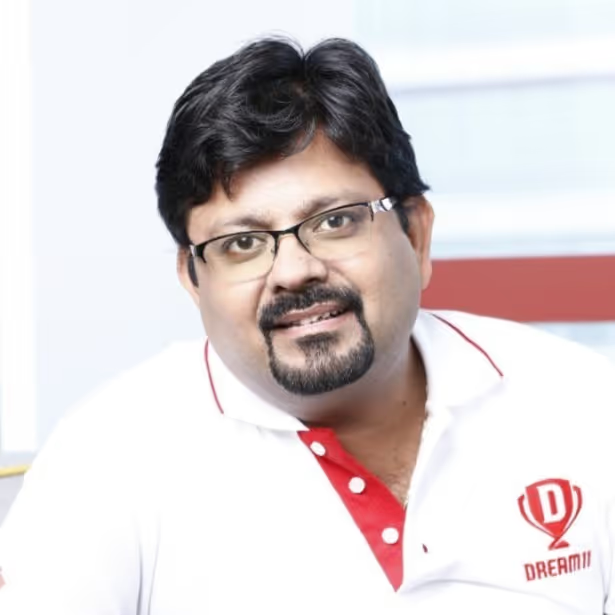
The only reference describing an actual delivery cadence, engineering to a schedule we could plan around.

n = 2f + 1), SST and gcache sizing, flow-control baselines, stale-read handling, and the MaxScale or ProxySQL routing layer in front of the cluster, and we make the proxy layer itself highly available.Grouped by the decision each one supports.
Scoping calls are not billed and do not commit you to anything. If the answer is that you do not need us, we will say so.